Cook Strait
Team Blog
Cook Strait – Ocean Seven Relay
Channel No. 6
11th March 2026
16 hours 22 minutes – 33.7 km
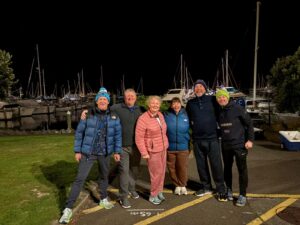
Team (in swim order): James O’Connor, Peter Bolger, Colin Wilson, Enda Sinnott, Sandra Goldsmith and Denise Underwood.
The Cook Strait is the only swim of the Ocean Seven located in the Southern Hemisphere. It separates New Zealand’s North Island from the South Island and connects the South Pacific Ocean to the Tasman Sea. It is famous for its strong cross-currents, powerful tidal flows and rapidly changing weather all of which combine to make it one of the most unpredictable swims in the world.
Many swimmers consider it the toughest of the Ocean Seven.
To put that into perspective, swim organiser Philip Rush once shared statistics he had compiled over the years. Out of roughly 500 attempts, only 167 have been successful. This season, now nearing its end, the success rate has been around 50%.
For our team, this swim had been ten years in the making.
We were originally due to swim here in March 2020, but just a week before departure the world shut down with Covid. Even this year our plans nearly unravelled again when the war in Iran disrupted flights the week we were due to leave. Thankfully we managed to reroute our travel through the United States and still made it to New Zealand on time.
The team arrived on 8 March. Conditions looked favourable for the 11th, but with channel swimming nothing is certain until the last moment. Confirmation finally came at lunchtime on 10 March.
That afternoon we met Philip for our briefing, where he reassured us the conditions were “near perfect.”
The schedule was straightforward:
Meet at the port at 4:30 am, travel 1 hour 30 minutes to the start point by boat, and begin the swim at 6:00 am.
Of course, things rarely go exactly to plan when the ocean is involved.
Our Ubers scheduled for 3:45 am never arrived, which felt like the first bad omen. Eventually we made it to the port, met the crew and settled onto the boat for the journey to the start.
Then the boat failed to start.
We all climbed off again and waited while the crew sorted the issue. Eventually the engine roared into life and we set off, pushing the swim start back to 7:00 am.
James was first up.
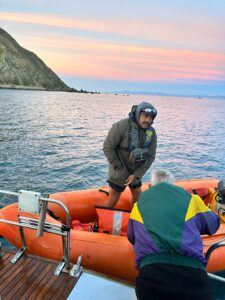
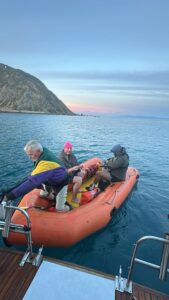
He climbed into the rib and was taken to the rocky cliff that marks the official start point. Once he touched the rock and began swimming, the relay was underway.
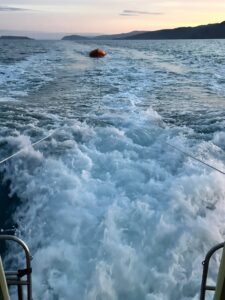
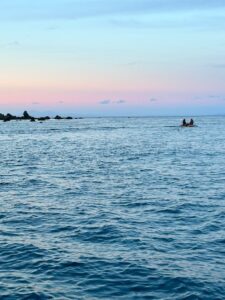
The rib is meant to guide the swimmer while the larger support boat communicates the direction of travel.
Except in the first few minutes, the rib lost power again.
James continued swimming, following the big boat, until the rib managed to restart and catch up with him.
And with that, the Cook Strait had begun.
The relay moved into its rhythm: James, Peter, Colin, Enda, Sandra and Denise, each taking turns in the water.
Sea conditions were far from perfect.
A large swell rolled through the strait, with a messy chop coming from several directions. None of us could really settle into a rhythm. Every stroke required extra effort simply to stay balanced.
We were also not as sea-conditioned as we should have been, which in hindsight was a mistake.
The water started around 16°C and dropped steadily to 13.5°C by the end of the swim, slowly draining energy.
During the first hour James and Peter both received multiple jellyfish stings. Thankfully once the sun rose the jellies seemed to disappear.
After six hours and thirty minutes we reached halfway and things were looking promising.
The chop continued but there were occasional short periods ten or twenty minutes where the sea allowed you to settle into a rhythm.
Our navigator Brett was extraordinary throughout the swim. He studied our progress constantly, analysing swim speeds, predicted tides and drift. Every adjustment he made was designed to keep us moving toward the narrow window that would allow us to reach land.
The second swim for each of us felt more enjoyable than the first.
But the standout moment belonged to Colin.
During his swim a pod of dolphins appeared, weaving beneath and alongside him for quite some time. When Colin climbed back onto the boat he was grinning from ear to ear.
Sandra and Denise probably faced the most difficulty with navigation. Both breathe to the left, and normally swimmers would position themselves on the right side of the rib where sighting is easier. However the swell kept pushing the rib to that side, so they had to swim on the left side of the boat, making it much harder to stay aligned and maintain direction.
After twelve hours, with James back in for his third swim, Brett gathered us for an update.
We could now see the cliffs of the South Island, about seven kilometres away.
Then he delivered the reality.
“Lads, there’s about 7 km left, but it could take another six to seven hours.”
The tide should have turned by then but it hadn’t.
Standing between us and our destination were The Brothers, the islands guarding the entrance to the Marlborough Sounds. If the tide turned at the wrong moment we could be swept past the islands and down the strait with no chance of reaching land.
The next few hours were tense.
A seven-hour tide had happened before, but what we experienced was eight hours without a turn, something rarely seen.
Sandra and Denise swam with incredible guts and determination during this period, and Denise had second brief visit from the dolphins. Eventually the tide held just long enough and James managed to position us perfectly for a slingshot approach past The Brothers.
Darkness fell as Peter entered the water with just four kilometres remaining.
The air and water temperatures dropped considerably. Jellyfish returned and the stings started again, but the sea had one last gift for us bioluminescence glowing beneath the swimmers and a sky full of stars above.
By now everyone was cold and exhausted.
Sandra and Denise organised a recovery routine the moment swimmers left the water warm water poured over them, quick drying, foil blankets, hot water bottles and constant encouragement.
It was care that came straight from the heart.
Finally Enda entered the water with just 800 metres to go.
It should have been quick.
Instead we found ourselves swimming through powerful swirling eddies that made forward progress almost impossible. It took Enda one hour and fifteen minutes to complete that final 800 metres.
But eventually he reached land.
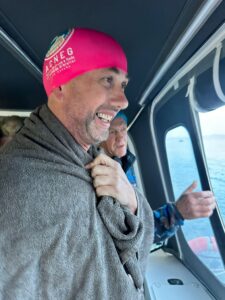
After 16 hours and 22 minutes, we completed the crossing of the Cook Strait.
The crew on this trip were extraordinary.
Mark and Moe sat in the rib for the entire swim, exposed to the elements and frozen by the end, guiding swimmers hour after hour.
Our captain Donald kept the boat steady throughout the long day and night, while our navigator Brett, assisted by Andy, worked tirelessly to calculate the safest and most effective route.
Their only goal was to get us to the end.
At no point were we discouraged. Even if the swim had taken 24 hours, they made it clear that as long as we kept swimming, they would keep going.
We also have to thank our coach Heike, who gave us a training plan that if we’re honest many of us felt we could safely ignore.
Most importantly, we want to thank our supporters at home family, friends and club members. Your messages kept us focused and gave us strength when we needed it most.
Special thanks must also go to our incredible groupies Kate, Audrey, Noeline and David who travelled with us, kept us grounded and reminded us to enjoy every moment of the journey.
But this swim was never just about the six swimmers in the water.
It represents the wider team whose previous channel swims made this possible:
Eamonn Colfer – English Channel
Saskia Dodebier – English Channel, Catalina Channel and Tsugaru Strait
James “Greenacres” O’Connor – North Channel
Andrew Roe – Strait of Gibraltar
Each of those swims built the experience and belief that eventually carried us across the Cook Strait.
And after ten years of waiting, the strait finally let us through.